
Clean Clothes Campaign urges all brands sourcing from Bangladesh to support workers’ demand to raise garment sector minimum wages to Tk 32,000.
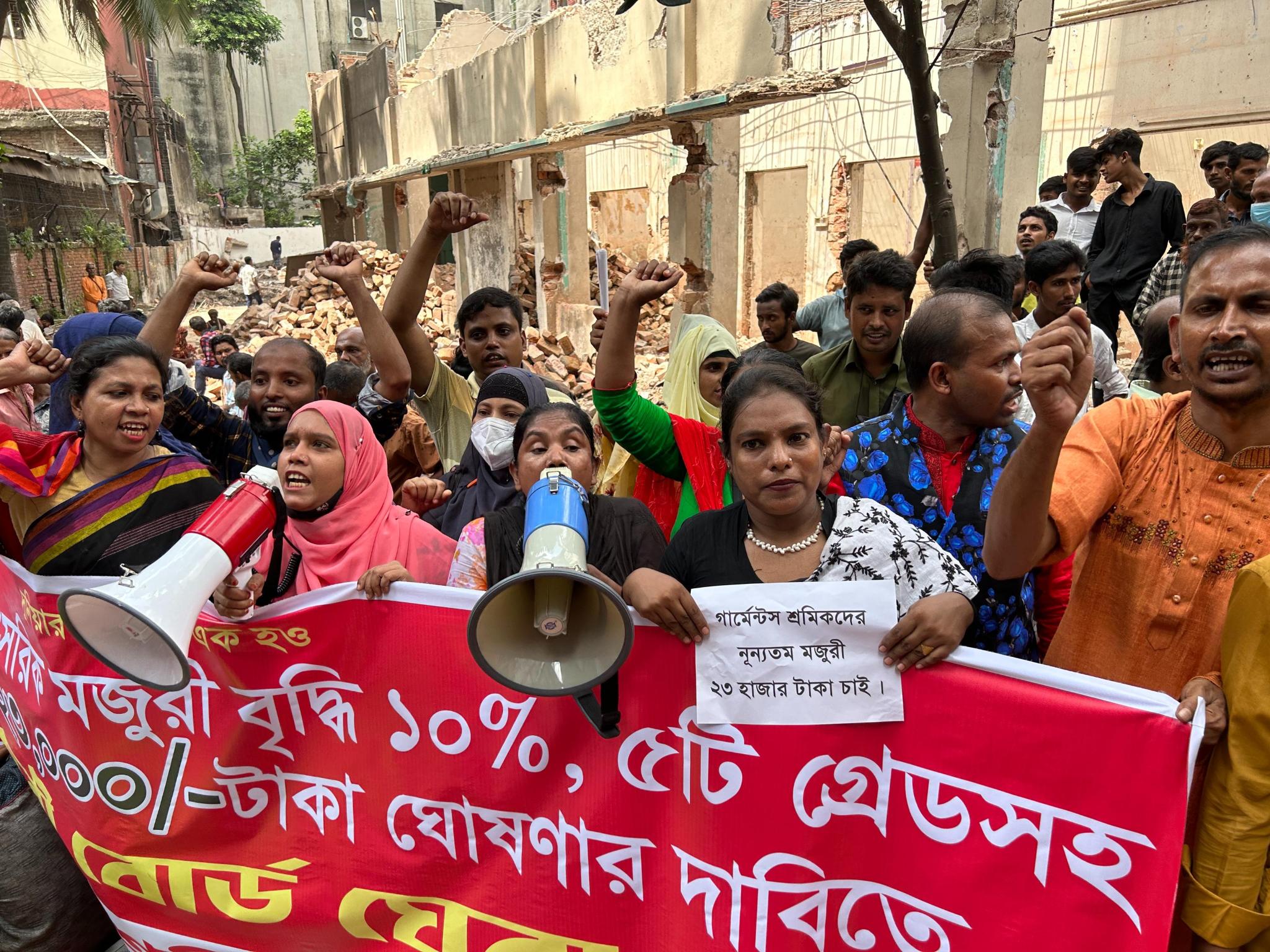
Workers protesting during the 2023 wage struggles
Over 600 factories in and around Dhaka haved closed due to protests that started last weekend by garment workers calling for a Tk 32,000 (260 USD, 230 EUR) minimum wage.
Alongside a minimum wage increase, workers are demanding an end to practices like blacklisting and union-busting. These demands should be taken up by the newly formed Wage Board. The Bangladesh Garment Manufacturers and Exporters Association (BGMEA) has threatened to invoke the “no work, no pay” provision if protests continue.
The current unrest resembles the 2023 minimum wage negotiations in Bangladesh. In 2023 the minimum wage for the sector was increased from Tk 8,000 per month to Tk 12,500 (100 USD) per month. The current minimum wage is far below the wage workers demanded back in 2023, Tk 23,000, a figure that was backed by thorough independent research by the Bangladesh Institute of Labour Studies. The decision to set the minimum wage at a meager Tk 12,500 sparked outrage across the sector. Workers who protested against not only the outcome of the wage negotiations, but also against the flawed decision-making process from which genuine labour representatives were excluded, were violently cracked down on by police. Four workers died, thousands were injured and 50,000 workers faced prosecution under one of many bogus criminal cases filed against unnamed workers.
Current minimum wage negotiations are taking place for Bangladesh's most important sector against this backdrop of historical tensions as well as the economic reality of high inflation (consistently above 8.5% for the past 3 years) and soaring prices of basic goods.
“Workers cannot get by on their current wages. Prices of basic necessities have doubled or more in the past years, while workers’ wages have remained at starvation level. In the meantime brands are banking profits year after year and wages of government employees have gone up by 100 - 142% recently. This is simply unfair, workers need Tk32,000,”
said Salahuddin Shapon, President of the Bangladesh Revolutionary Garments Workers Federation & General Secretary of the IndustriAll Bangladesh Council.
"Workers know very well what they are risking when they go and protest. But the unrest that we have seen in the past couple of days is the result of a strong feeling of injustice about how wealth is distributed in this supply chain, and years of trying to get by on a wage that is simply not enough,"
said Kalpona Akter, President of the Bangladesh Garment & Industrial Workers Federation.
Garment exports from Bangladesh increased by 4.9% to $3.17 billion in October 2026, from $3.02 billion in October 2025. Brands like H&M, Zara, Primark and Uniqlo - all with a significant presence in Bangladesh - have all recorded 10-digit profits in 2025: Inditex (Zara): 6.2 billion USD, Fast Retailing (Uniqlo): 4.5 billion USD, H&M: 1.8 billion and Primark (part of ABF): 1.4 billion.
International brands must publicly commit to continue sourcing from Bangladesh and ring-fence labour costs or offer commercial terms that enable the payment of the new minimum wage to ensure that the government and employers do not fear a loss of production to other countries.
“It is crucial that brands act immediately and speak out in support of workers’ demands rather than waiting until the wage negotiations are over. In a recent survey conducted by Clean Clothes Campaign of over 1,000 workers in Bangladesh, 89% of workers reported that their wage is not sufficient to cover their family’s basic expenses. Supporting a wage demand put forward by trade unions should not be controversial, especially for brands that claim to be committed to paying workers a living wage”,
according to Anne Bienias from Clean Clothes Campaign.
That is why Clean Clothes Campaign calls on all brands sourcing from Bangladesh to:
- Publicly support the demand for Tk 32,000 per month,
- Publicly commit to continue sourcing from Bangladesh after the new minimum wage increase,
- Call on their suppliers, the BGMEA and the BKMEA to support and implement the Tk 32,000 per month increase,
- Fully absorb the higher labour costs in their purchasing prices,
- Make sure their suppliers do not use violence, or approve of the use of violence, against protesting workers, refrain from blacklisting or firing workers who engage in protests, respect the right to freedom of association and do not file criminal cases against protesting workers